
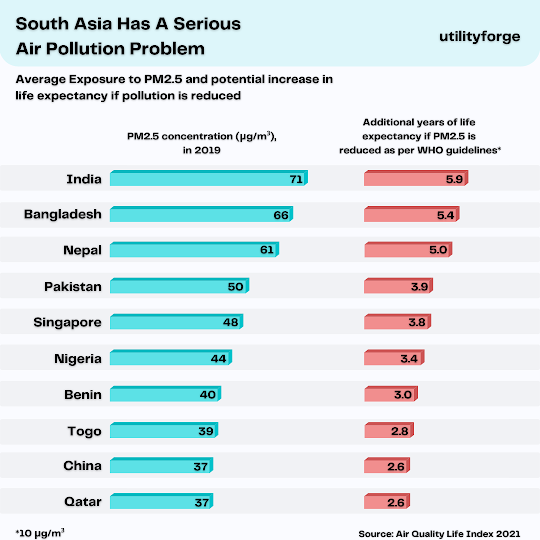
According
to the new data published in the Air Quality Life Index (AQLI) 2021,
the average person on the planet is set to lose 2.2 years of their life
if the exposure to PM2.5 is not reduced to meet the World Health
Organization’s (WHO) guideline (10 μg/m³ ).
Particulate pollution is said to have a higher impact on life expectancy than communicable diseases like tuberculosis and HIV/AIDS.
The matter is worse in many South Asian countries as the ambient air pollution can reduce a person's life by as much as 5-6 years (average).
Air pollution in India is likely to reduce the life expectancy of an average citizen by 5.9 years and close to 9 years for about 480 million people living in the central, eastern and northern parts, including the capital, New Delhi and surrounding territories.
National Clean Air Program (NCAP) launched by the Indian government in 2019 aims to reduce pollution in the 102 worst-affected cities by 20%-30% by 2024 by ensuring cuts in industrial emissions and vehicular exhaust. The effectiveness of this programme remains to be seen
Particulate pollution is said to have a higher impact on life expectancy than communicable diseases like tuberculosis and HIV/AIDS.
The matter is worse in many South Asian countries as the ambient air pollution can reduce a person's life by as much as 5-6 years (average).
Air pollution in India is likely to reduce the life expectancy of an average citizen by 5.9 years and close to 9 years for about 480 million people living in the central, eastern and northern parts, including the capital, New Delhi and surrounding territories.
National Clean Air Program (NCAP) launched by the Indian government in 2019 aims to reduce pollution in the 102 worst-affected cities by 20%-30% by 2024 by ensuring cuts in industrial emissions and vehicular exhaust. The effectiveness of this programme remains to be seen


Comments
Post a Comment